Can plasma exchange offer a new clue to HCC recurrence after liver transplantation?
- Publication state
- PublishedPublished after author review.
- Evidence basis
- 3Connected public source records listed below.
Post-transplant plasma exchange was associated with better HCC-specific recurrence-free survival in one retrospective study. This is a reason to investigate further—not proof that plasma exchange prevents cancer recurrence.
The 2023 study, first-authored by Namkee Oh, examined 152 patients with hepatocellular carcinoma (HCC) who underwent ABO-incompatible living donor liver transplantation at Samsung Medical Center. Propensity-score matching produced 54 matched pairs, grouped according to whether postoperative plasma exchange was performed.
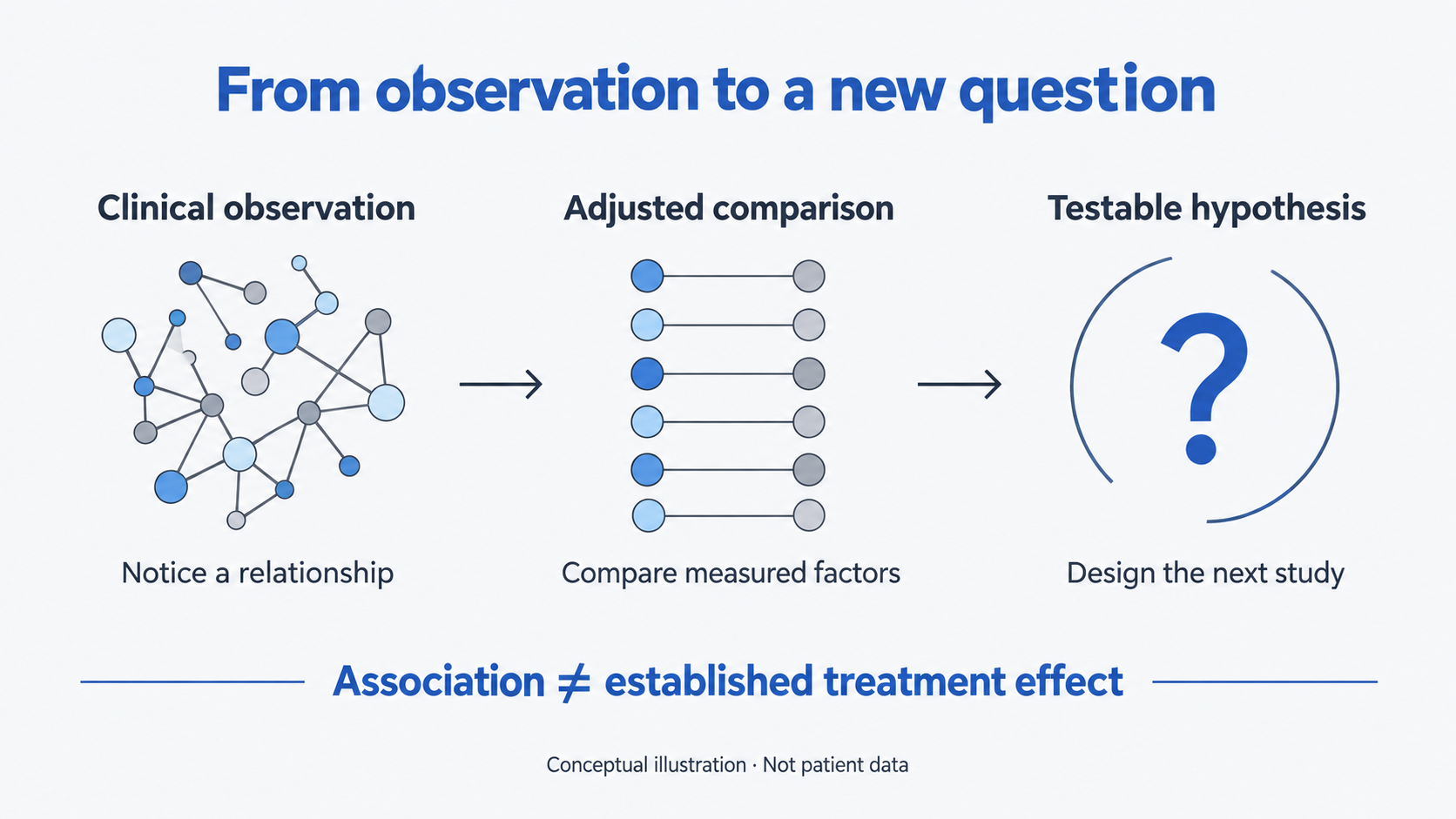
The value of this observation is the research question it opens: could an aspect of post-transplant care also influence cancer recurrence?
Answering that question requires distinguishing an observed association from an established treatment effect. Matching can improve comparability for measured characteristics included in the analysis. It does not randomly assign treatment or eliminate unmeasured confounding. Why and when patients received treatment also matter when interpreting an observational comparison.
The editorial takeaway is that a finding does not need to become an immediate treatment recommendation to matter. Clinical observations can identify a relationship worth testing more directly, with a clearly defined population, treatment strategy, and comparison.
This study concerns a specific transplant setting, not all patients with HCC. It should not be read as a recommendation for routine plasma exchange to prevent recurrence. The next scientific task is to determine whether the observed relationship reflects a treatment effect, other differences between patients, or a combination of both.
혈장교환은 간이식 후 간암 재발에 새로운 단서를 줄 수 있을까요?
한 후향적 연구에서 이식 후 혈장교환은 더 나은 간암 특이 무재발생존과 연관되어 있었습니다. 추가 연구가 필요한 단서이지만, 혈장교환이 암 재발을 예방한다는 입증은 아닙니다.
오남기가 제1저자로 참여한 2023년 연구는 삼성서울병원에서 혈액형 부적합 생체간이식을 받은 간세포암 환자 152명을 분석했습니다. 성향점수매칭 후에는 수술 후 혈장교환 시행 여부에 따라 54쌍을 비교했습니다.
이 관찰의 가치는 새로운 연구 질문을 연다는 데 있습니다. 이식 후 관리의 한 요소가 암 재발에도 영향을 줄 수 있을까요?
이 질문에 답하려면 관찰된 연관성과 입증된 치료 효과를 구분해야 합니다. 매칭은 분석에 포함된 측정 변수에 대해 두 집단의 비교 가능성을 높일 수 있습니다. 하지만 치료를 무작위로 배정하거나 측정하지 않은 교란요인을 제거하지는 않습니다. 관찰연구를 해석할 때에는 환자가 왜, 언제 해당 치료를 받았는지도 중요합니다.
이 글에서 제안하는 해석은 연구 결과가 곧바로 치료 권고로 이어져야만 의미 있는 것은 아니라는 점입니다. 임상적 관찰은 대상 환자, 치료 전략, 비교 조건을 명확히 정해 더 직접적으로 검증할 관계를 발견하게 해줍니다.
이 연구는 특정 간이식 상황을 다루며, 모든 간암 환자에게 적용되는 결과는 아닙니다. 재발 예방을 위해 혈장교환을 일상적으로 시행하라는 권고로 읽어서는 안 됩니다. 다음 연구의 과제는 관찰된 관계가 치료 효과인지, 환자 간 다른 차이에서 비롯된 것인지, 또는 둘 모두인지 구분하는 것입니다.
Connected public evidence
Improved recurrence-free survival in patients with HCC with post-transplant plasma exchange · PMID: 37029084
Source article · Liver Transplantation (2023) · DOI: 10.1097/LVT.0000000000000147
Methodological background · Austin: Optimal caliper widths for propensity-score matching · DOI: 10.1002/pst.433